Showing posts with label fleet. Show all posts

Thursday, August 19, 2010

Great article about EgyptAir

Interview: Egyptair group chairman Hussein Massoud

With the end of a renewal phase in sight, EgyptAir Group chairman and chief executive Hussein Massoud is turning the focus onto capitalising on its key geographic advantage

For EgyptAir the pieces of the jigsaw are coming together. There is group profitability, Star Alliance membership, a new dedicated terminal at its Cairo base and investment in new aircraft, bringing its fleet and onboard product bang up to date. Indeed, by the time IATA's annual general meeting rolls into Cairo next summer, itself another sign of EgyptAir's growing presence on the global stage, the carrier will have all but renewed its fleet.

Yet this is just the start. Current fleet plans largely focus on renewal, but growth is on the long-term horizon. "EgyptAir has to be bigger," says Hussein Massoud, chief executive and chairman of EgyptAir's holding company. "We have ambitious plans from 2014 to 2020 and from 2020 to 2025. These will be decided by the end of the year, but I think it will be a very ambitious plan. The key opportunity for us is that we will enlarge our network, either by adding new destinations or by increasing frequencies. We have a special chance concerning Africa. I think we have a good product, with more cause for customer satisfaction."

Egyptair Massoud (445) Billypix
All pics Billypix
Like the country itself, EgyptAir has a long history. The airline dates back nearly 80 years. But it is the transformation begun in the first half of the last decade that has laid the foundations for today's strategy. This created a holding structure in which the airline is the largest of nine subsidiaries, and a change in ethos to focus more on business traffic. The airline was previously built around leisure and ethnic traffic, reflecting the dynamic tourism and population of Egypt. Its network was revamped, fleet modernisation initiated with Airbus A330-200s and a path began that ultimately led to alliance membership. By October 2007 EgyptAir was Star Alliance bound and just nine months later it formally joined. It has since emerged as one of the more enthusiastic alliance members.

Nowhere is this more evident than at Cairo's Terminal 3, which opened just under two years ago and helps drive EgyptAir's hub aspirations. Cairo became the first Star Alliance home carrier airport to feature a dedicated Star Alliance-branded lounge. EgyptAir still owns and operates it, but brands it Star Alliance. "One of the priorities of Star Alliance is its move-under-one-roof concept," says Massoud. "With a dedicated EgyptAir and Star Alliance terminal, we had a very good opportunity from day one.

"With Star Alliance we think we are the gate to Africa," he adds. The carrier works closely with Star member South African Airways to connect Africa to other Star hubs through Cairo - and could develop this further with a connection in central Africa if Ethiopian Airlines' Star Alliance interest comes to fruition. EgyptAir, which has just added flights to Dar es Salaam in Tanzania, Nigerian city Abuja and most recently to Juba in southern Sudan, now has 17 destinations in Africa. "We are looking to double this over the next five years, or maybe four," says Massoud. "This is where we will grow."

This role builds on Egypt's location, straddling the top of Africa and the Middle East, with Europe above it. It puts much of the three continents firmly on its radar within a five hour flight time and its location is a recurring theme when Massoud talks of the strength of the carrier. "We have a very competitive geographical location," he says.

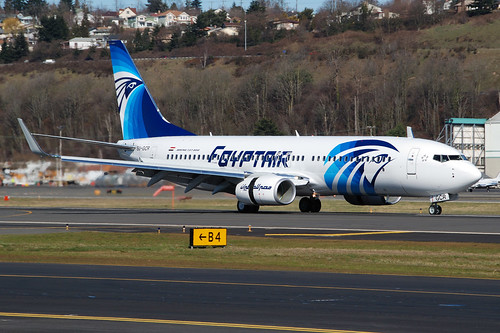
To build on this position and with its Star role in mind, EgyptAir adjusted its network and fleet strategy accordingly. "We give more attention to short- and medium-haul routes and we increased our single-aisle fleet," he explains. It replaced part of its Boeing 777-300 order to take eight more 737-800s. "Our plan is more destinations in the medium- and short-haul market. We will also increase frequencies to key destinations like London Heathrow, Paris, Amsterdam and Istanbul."

New 737-800 flights to Copenhagen will begin in October, marking a return to the Danish capital after six years. "This time the game has changed," says Capt Alaa Ashour, chairman and chief executive of the EgyptAir mainline operation. "The route has changed, the partner [now Star Alliance member SAS] has changed, the whole elements have changed."

HOLDING FIRM

Massoud Egyptair (200) Billypix
EgyptAir's holding group includes operating airlines EgyptAir, EgyptAir Cargo and regional unit EgyptAir Express. Its ground, in-flight and engineering services subsidiaries support these operations, while tourism, duty free and medical services are among its other interests. "Each is a profit centre and we get the benefits from synergies," says Massoud, crediting this as contributing to turning from a loss-making to a profitable operation. It netted profits of 573 million Egyptian pounds ($100 million) to June 2009 and aims to lift profits for the year ahead. "EgyptAir is our black horse, it represents around three-quarters of revenues, but we rely on synergies between the subsidiaries. We have to grow all the subsidiaries to get better results," he says, adding there are no plans for any sell-offs. "If we think any are not of benefit to the others, we will get rid of it. But for the time being, that is not in our thinking."
On long-haul the carrier serves a number of routes and is likely to add to its North American destinations - currently it serves New York JFK - when it adds its last two 777-300ERs next year. North American Star Alliance partner hubs in Chicago, Toronto and Washington are all candidates. "We are concentrating our long-haul operations on the profitable and prestige routes," says Massoud. "And we use the huge network of Star Alliance for routes we couldn't, or wouldn't want to, operate ourselves.

"The main objective of Star Alliance is to offer better services for the passenger so we'd like to use much [of the new 737-800 capacity] to Africa. We want the passenger of Star Alliance not to feel any different when travelling from Cairo to Africa. Our objective is to enhance our in-flight service with a new product to match the requirements of Star Alliance."

While many carriers slowed capacity plans in the crisis, EgyptAir sped up its fleet renewal. August saw the first of five A330-300s arrive - a year earlier than planned. The remainder follow next year. The A330s are part of a swathe of deliveries which has already seen two 777-300s arrive this year. Four more 777-300s and eight 737-800s will follow over the next 18 months. "We have got the benefits of the recession," says Massoud of the new arrivals. "We signed the contract with Boeing [for 737-800s] last July and we receive the first aircraft within 13 months." The timing looks opportune, given the swelling of the manufacturer orders book at the recent Farnborough air show.

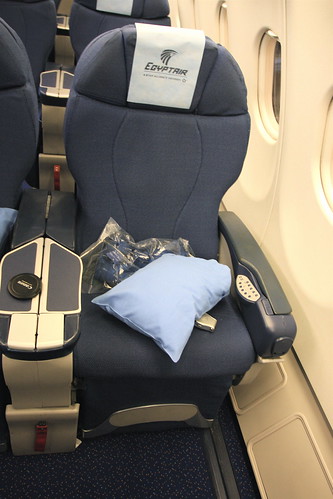
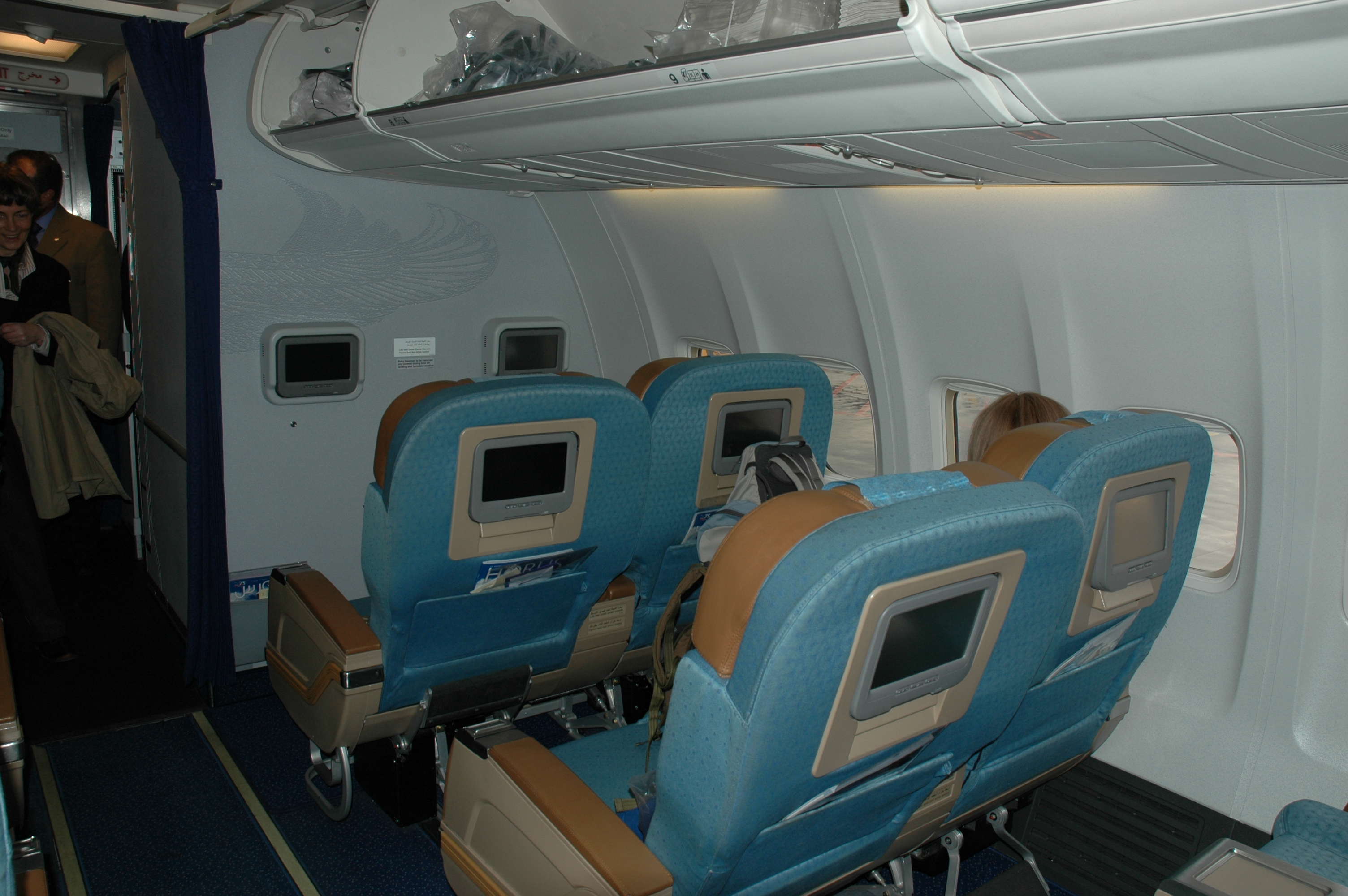
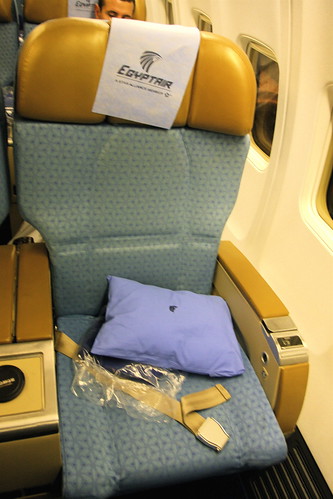
There is also an enhanced onboard product. The carrier, which offers a two-class cabin system, is focusing on raising standards in the business cabin. Its new A330-300s feature lie-flat seats in business class, a new Panasonic in-flight entertainment system and OnAir's in-flight wi-fi service and mobile connectivity. Its 737-800s will feature an enlarged business cabin, with 24 seats in a generous 48in (122cm) pitch to create wider cabin feeling, in a bid to increase its premium revenues.

"All our marketing campaigns, everything we invest is in the business class, which then feeds into the economy cabin," explains Ashour. "People know they get a premium class product and that they will get value for money in business class. This is how we are trying to be competitive with the aggressive competition in the market."

Massoud adds: "We have enhanced and upgraded our product; this gives us a chance to increase the yield. We have restructured our pricing system and we have not forgotten about the cost-cutting side. That remains very important. We identify the big areas of cost and then we decide how to apply cost savings." Distribution is one potential area where the carrier hopes for savings by increasing online bookings by upgrading its website.

Ashour and Massoud have been in their current positions since September last year, although both were already established figures at the carrier. Ashour has been a pilot at the airline since 1988 (see box story) while Massoud - after a 20-year career in the Egyptian air force and heading aviation companies Smart Aviation and Mitrage - was vice-chairman of the holding company for a year and a half before taking on the top job.

Massoud says his objective on taking the role has been to "keep, but enhance and upgrade" the company's reputation. But before he could look at the long term, he faced a more immediate issue. EgyptAir in the summer of 2009 was given a warning by the European Commission that it risked being placed on its blacklist of international carriers banned from operating in EU airspace because of safety concerns in several areas of its operation. "It's the first challenge I faced because EgyptAir was confronting a very bad situation," says Massoud. "Concerning safety, we did not have a problem," he says, characterising the problems as smaller issues that reflected a different cultural approach. "This had to change to be with international norms. We had a misunderstanding between our

WALKING THE TALK

Ashour Egyptair (200) Billypix
Heading the airline since September 2009 is Capt Alaa Ashour, who as a pilot with EgyptAir for more than 20 years has flown just about every type it has operated during that period. As the carrier strives to enhance service levels to ensure it remains competitive and meets business travellers requirements, he stresses the need for the leadership to set an example in attention to detail. Indeed while the carrier is state-owned, he stresses it is run as a private business.

"Managers from the top level show how much they care about the detail. Nothing is left unturned, everything has been reviewed," Ashour explains. "The employees started to feel that everything matters, everything was important and that the customer is number one. Employees must trust management. People know that the management is on top of everything and there is a very well defined vision and good communications. This is how we drive the change. We walk the talk."

Ashour himself remains a regular on the EgyptAir flight deck and hopes there will be more opportunities to fly now that much of the heavy strategy work on EgyptAir's long-term plan has been finalised. "Maybe I will have more time to fly," he says. "I try to do one flight a week, or at least every two weeks." And besides a love of flying, he believes there are strategic benefits to him continuing to fly. "It is an advantage being chairman and chief executive and at the same time flying. I get to see what is going on day to day. It keeps me in touch with everything, because I do it myself and I know what is going on. I work with everybody - pilots, cabin crew, ground staff."

culture and the culture [of the EU]."

Continued dialogue between the EC and the Egyptian authorities has helped allay concerns, evident by the absence of EgyptAir from subsequent EC safety updates. In March this year the EC reported the Egyptian air safety authorities were carrying out its responsibilities correctly and that it would it continue to co-operate closely with the Egyptian authorities to ensure the proposed improvements could be implemented. "Since last October we didn't have a single significant remark," says Massoud of the monitoring of the airline. He also highlights IOSA certificates for 2004, 2006 and 2008 and European Aviation Safety Agency reports in 2006, 2008 and this year.

Neither was the issue damaging to its customer proposition, as passenger numbers jumped 8% to 7.2 million in 2009. This, in part, also reflected Africa and the Middle East being relatively unscathed from the economic crisis. "EgyptAir was not affected as much by the recession because of our geographic location, traffic seasonality, large number of expatriate workers and our increased destinations," says Massoud. "We still saw yields down, but were still profitable."

Massoud identifies the economy as the biggest factor in the year ahead. "The improving economic situation of Egypt undoubtedly affects the situation of Egypt. There is a direct relation between GDP and the air transport industry," he says. But while the economic picture is relatively bright for Africa and the Middle East, the carrier is not untouched by Europe's economic woes. "Around 30% of our revenues are attached to Europe. So we'll be affected. But I think next year Europe will start growing again and will recover much faster than anyone thinks."

He also sees a number of challenges aside from economic factors, with Massoud highlighting fuel price fluctuations and the increased presence of low-cost carriers among them. The fledgling low-cost carrier sector in the Middle East continues to grow, and in Egypt was stepped up in June when Air Arabia Egypt launched flights. The carrier, established by Air Arabia in co-operation with Cairo travel firm Travco Group, is operating flights out of Alexandria. "We have to change our structure a little bit, we have to react," acknowledges Massoud, pointing to the growing share of low-cost carrier traffic in the market. He does not give specific plans, but notes: "We have to get non-traditional solutions."

Ashour also points to the challenge the carrier will ultimately face from Open Skies developments, low-cost carriers for example are still to gain access to Cairo International airport. Ashour says the carrier must prepare and plan to be ready for Open Skies and the new competition and opportunities this brings.

The challenging competitive landscape, together with the opportunities its location, Star membership and new fleet brings, will drive EgyptAir's development. Work on the new long-term strategy is being finalised and should be complete by year-end. The expansion could see a 72-aircraft fleet in 2012 expand by a quarter in the next strategic phase, building an operation capable of both tapping the potential from its location, while defending its market. Just as Egypt's most famous landmark the Pyramids has for centuries brought both


Source

Tuesday, March 2, 2010

Wonderful article about Cairo Airport and Egyptair

Middle Eastern Star

By Cathy Buyck
Air Transport World, March 2010, p.20

EGYPTAIR HAS NO AMBITION TO BECOME A FIVE-STAR AIRLINE with exclusive first-class suites and luxury spas in its lounges, at least not for the present. Yet it is aiming to give its expansionistic Middle East and Gulf counterparts a cookie of their own dough with an increasingly effective strategy to source flow traffic over its Cairo hub supported by its membership in Star Alliance and a strong determination to gain, or regain, market share.

"We're facing intense competition from Gulf carriers and they have planned major capacity growth. Furthermore, we're disadvantaged in terms of resources but we have to deal with that," Alaa Ashour, chairman and CEO of the Cairo-based airline, states in down-to-earth fashion. However, he tells this magazine EgyptAir has some major assets to support its competitive prospects including a "long and strong history" as a flag carrier whose origins date back to 1932, low unit costs, a large home market (Egypt is the Middle East's most populous country with a population of more than 80 million), a homogeneous workforce and, last but not least, a government that applies an open skies policy only to its regional airports (see article p. 28). Foreign airline access to Cairo International remains regulated by bilaterals and it is a stronghold of the national carrier, which holds 60% of departure slots there, according to Ashour.

Despite this strong position, and no indication from the Ministry of Civil Aviation that it will change its stance on CAI, Ashour is convinced that EgyptAir has to prepare for open skies. "Liberalization in the Middle East, in Egypt, will come. We have to be ready," believes the 45-year-old pilot who was appointed chairman and CEO of the airline in September, signaling rejuvenation at the top. "We are doing our best to have a competitive product. This is one of the reasons why we are modernizing our fleet."

MS took delivery of 12 new 737-800s over the past two years and has firm orders for a further eight narrowbodies and orders and options for 14 widebodies for delivery between now and 2014 (see table, page 22).

Fourteen older aircraft including its 777-200s, 737-500s, A340s and some A320s will be retired, but as EgyptAir Holding Co. Chairman and CEO Hussein Massoud points out: "The market is not very attractive to sell them now. We have a contingency plan for some aircraft if we can't sell them. The A340s might get new interiors." By 2014, EgyptAir's fleet should comprise 72 aircraft compared to 64 at the end of 2009 and 32 in 2002.

This month, EgyptAir Airlines will take delivery of its first new 777-300ER, which will feature its first fully lie-flat beds and be the first aircraft to enter the fleet on an operating lease (from GECAS). All other mainline aircraft are owned. Regional affiliate EgyptAir Express deploys 12 owned E-170LRs while EgyptAir Cargo flies two A300B3-200Fs and two A300-600Fs. The three carriers operate under the same AOC but are managed separately and have their own P&L accounts. In aggregate, they operate some 1,200 weekly flights to 72 destinations worldwide.


Holistic Turnaround

In fact, EgyptAir is doing a lot more than a fleet renewal. It launched a major corporate reengineering in 2002, when its structure was changed from a governmental organization into a holding company with subsidiaries. The move coincided with establishment of the Minister of Civil Aviation and the government's ambitious strategy to modernize and upgrade its airports and airline.

"The two are interconnected; overhauling [just] the airports or the airline would have made no sense as they affect each other," Massoud states. As a textbook example that the government's strategy is correct, he cites the synchronized joining of EgyptAir into Star Alliance in July 2008 and the opening of CAI's new Terminal 3 in December, enabling efficient hub functionality for both airport and airline.

EgyptAir's membership in Star, and the consequent adoption of all its standards, also "proves how committed we are to promote our company," he says, stressing that MS has changed "a lot" since it was given the right to operate without any interference from the government and the duty to do so without any financial backing. "It became a different airline," he asserts. EgyptAir Airlines indeed has come a long way since its incorporation. It established a 24-7 Integrated Operations Control Center, became the first airline on the African continent to be IOSA certified in 2004 and outlined a new network strategy initially with Sabre Airline Solutions Consulting and now with Seabury APG, resulting in a hub model connecting Africa, Europe and the Middle/Far East over CAI. Transfer traffic is 15%-20% at present and should reach 30%-40% in a couple of years. In March it will start assessing the third and final phase of its network optimization, which will lead to reorganization of its flight schedule into multiple banks from the next winter schedule compared to two at present.

It also modernized its IT infrastructure including a cutover from its in-house legacy passenger service system to Amadeus's Altea customer management solution, transferred its domestic operations to a new subsidiary in response to the liberalization of the domestic market in 2006, updated its frequent-flyer software and program, launched a new corporate identity with a more dynamic look and new aircraft livery in 2008, "and so much more and so much more to come," Ashour laughs.

In the next months, for instance, MS will be moving from the more segment-based PROS RMS revenue optimization tool to PROS' O&D Solution and it will enhance the functionality and usage of its Internet booking engine. At present, just 5%-6% of bookings are made online.


Competitive Unit Cost

The new approach did deliver results, with a substantial improvement in all of its performance metrics. Compared to 2003-04, aircraft utilization rose from 9.25 daily block hr. to 11.01 in its most recent financial year ended June 30, 2009. Flight punctuality improved from 79.1% to 87.5% and passenger load factor lifted from 64% to 67.4%. The number of passengers carried grew from 4.5 million to 7.1 million excluding Express, which accounted for an additional 1.3 million boardings. Traffic more than doubled in the six-year period from 8.96 billion RPKs to 16.16 billion on an 85% hike in ASKs from 13.04 billion to 23.9 billion.

Its financial performance also improved. EgyptAir Airlines has been consistently profitable over the past five years after posting a net deficit of EGP247 million ($44.8 million) in its first year as an independent company. In fiscal 2007-08 it reported record earnings of EGP231.9 million on revenue of EGP9.3 billion, up 43% and 34% respectively over the prior year. For the year ended June 30, 2009, net earnings amounted to EGP207.6 million on revenue of EGP9.9 billion. "Many carriers faced difficulties or reported heavy losses during the financial crisis. Fortunately, we realized a profit in all our subsidiaries in the last financial year and even in the first half ended Dec. 31," Massoud boasts. The company does not publish half-year results, but the chairman indicates "results were better than anticipated and we foresee a full-year profit for fiscal 2009-10." Passengers carried in the first half decreased 4% compared to the year before as RPKs rose 3% on a 2% increase in ASKs.

EgyptAir has been affected by the industry downturn, he says, but not to the same extent as some carriers in Europe, the US and the Far East owing to its strategic location at the crossroad of Africa and the Mideast, steady Hajj and Umrah traffic, "which guarantees a part of our profit," and ethnic travel. Hajj and Umrah traffic represents up to 10% of international enplanements yearly, although this has been halved to 4.5% owing to H1N1. Networkwide yields fell about 8%-10% in FY08-09 and the first half of FY09-10. "We'll remain profitable but we are under extreme pressure," Ashour concedes. "Yields are going down and unit costs are going up owing to higher fuel prices and extensive product upgrades." He figures the year-on-year CASK increase will "not be less than 10%-15%" after years of a stable level at "between 5 and 8 dollar cents," which he accurately describes as "very competitive" for a full-service carrier.

While emphasizing that MS will stay loyal to its heritage as a full-service network carrier, Ashour argues that it has to target all segments and explore all options to grow revenue as yields stay under pressure. "We have to be flexible, innovative," he reasons. "There is no longer an exact model; everybody is a hybridLCCs and FSCs alike."

EgyptAir recently set up an in-house commercial R&D department and "will be rewriting its strategy," he says, cautioning, however, that unbundling "is a plan for the future." Its operations at Alexandria could become a noteworthy exception to its full-service philosophy owing to major inroads made by Mideast LCCs into Egypt's second-most-populous city.

"We'll strengthen the base in a 'smart' way," Ashour says, yielding that "maybe" a switch to a low-cost model is on the agenda. Changes are expected to take place from next winter's schedule. It currently flies from Alexandria El Nozha to Cairo and six destinations in the Middle East with a pair of A320s. EgyptAir Express operates to an additional seven domestic destinations.

Meanwhile, the carrier is moving forward with a comprehensive product upgrade throughout its fleet, including new catering and a reinforced "we care" service approach. At the end of January it commenced a vast training program for its 7,300-strong workforce, involving everybody from the call center to station managers to flight crew, about the importance of customer service. This will extend to all its related subsidiaries such as EgyptAir Maintenance & Engineering, EgyptAir Ground Services and EgyptAir In-flight Services.

Human Capital

"We are investing a lot in human capital; it is part of our strategy. It's our objective to reach a better customer satisfaction through offering a good network, a good product and a good service. We would like EgyptAir to be recognized for a competitive customer service with the unique Egyptian spirit," Massoud explains, noting that "buying aircraft takes two to three years, building a new terminal takes two years, but building up human capital takes at least ten years."

With the arrival this month of its first 777-300ER, which will operate initially on the CAI-London Heathrow route, MS formally starts phasing out its first class that currently is available on the 777-200s and A340s. The 777-300ERs come in a two-class configuration, with 49 fully lie-flat seats in business and 291 seats in the economy cabin, which will be equipped with individual IFE units. Its new A330-300s will feature a similar configuration with 36 business class seats and 260 seats in economy.

"With the fully lie-flat seats we see no need for a first class," Ashour says. "It also reduces costs and complexities." Its new narrowbodies feature an equally comfortable layout, with 24 business class seats with a 48-in. pitch and 120 economy seats. All seats have individual IFE. "Demand in business is still very strong," Massoud confirms. The first four 737-800s had only 16 seats in business, but the number was upped on subsequent deliveries owing to strong demand. Those four will be refitted with an additional eight business class seats.

EgyptAir Airlines' winter timetable has it operating 441 weekly flights on its international network spanning 60 destinations in 44 countries. With 20 airports served, Europe remains its biggest market and "most profitable region," Massoud reveals. It serves 16 Mideast destinations and an equal number in Africa, but in line with its own and Star's network strategy it is looking to expand its footprint on the continent, mainly to West Africa. It is also in discussions with Star partner South African Airways about "cooperation to explore all possibilities to grow the African markets." Ashour remains tight-lipped about rumors that this could lead to a JV airline feeding EgyptAir's hub in the north and SAA in the south.

In general, MS adds two to three destinations per year. In 2009 it commenced four-times-weekly service to Abuja and Dar Es-Salam and a twice-weekly to Almaty. EgyptAir Express added Taba to its network. MS is doing a market analysis on several new destinations including Mauritius, Abidjan, Lusaka, Dakar, Douala, Toronto, Washington and Chicago. It aims to bring one new African and one new European destinationCopenhagen or Manchester online this summer, and an American destination in summer 2011

"We want to have a worldwide coverage with our own flights but we use codeshares and Star to get to destinations which make no commercial sense to fly on our own," concludes Massoud. "We are the national carrier of Egypt, but we have to be profitable."


Source: ATW Online

Friday, January 22, 2010

Egyptair, Enjoy the sky

Egyptair was founded in 1932 as Misr Airwork.

Egyptair is the fastest growing airline in Africa. Egyptair (Airline code: MS) Is member of the biggest airline alliance: Star Alliance. The home base of Egyptair is Cairo international Airport, Egypt. Egyptair operates their flights from the new and state-of-the-art Terminal 3 at Cairo Airport.


Egyptair wants to be an important connexion between Europe and Africa. Most of the Egyptair routes are going to Europe and Africa.

Egyptair Express is a regional airline of Egyptair. Egyptair Express operates domestic flights in Egypt  and International to Libya and Europe.

EgyptAir's Fleet
The EgyptAir fleet has an average age of 5.2 years and consists of the following aircraft (at October 2010):
EgyptAir Fleet
Aircraft In
service
Orders
(Options)
Passengers
(First/Business/Economy)
Notes
Airbus A320-200 13 0 145 (0/16/129)
144 (0/10/134)
171 (0/0/171)
5 in the 145-seat configuration
7 in the 144-seat configuration
1 in the 171-seat configuration (operating domestic flights only)
Airbus A321-200 4 0 185 (0/10/175)
Airbus A330-200 7 0 268 (0/24/244)
Airbus A330-300 1 4 (3) 301 (0/36/265) OnAir internet and mobile usage capability
New business class featuring lie-flat beds.
Economy cabins will be equipped with PTV
Deliveries: 3 in Q1 2011 and 1 in Q1 2012
Airbus A340-200 3 0 260 (12/24/224) Fleet to be gradually retired from "unknown" or they will stay with EgyptAir and get a retrofit with 777-300ER and A330-300 cabins.
Boeing 737-500 4 0 104 (0/8/96) SU-GBK operates Air Sinai flights
2 aircraft leased to Sudan Airways between August–November 2010.
Boeing 737-800 14 6 160 (0/16/144)
144 (0/24/120)
4 in the 160-seat configuration (to be reconfigured to 144-seats from 2011)
8 in the 145-seat configuration
Deliveries: 4x 2010 (from September 2010), 2x 2011 and 2x 2012 (by August 2012).
Boeing 777-200ER 5 0 319 (12/21/286) 3 aircraft to be retired in 2010
Boeing 777-300ER 3 3 346 (0/49/297) Deliveries: 1x December 2010, 2x 2011
All aircraft leased from GECAS
New business class featuring full lie-flat beds
New economy cabins are equipped with PTV
Total 54 13 (3)
Last updated: October 2010
EgyptAir Express Fleet
Aircraft In
service
Orders
(Options)
Passengers
(First/Business/Economy)
Notes
Embraer E-170 12
76 (0/0/76) Operating for EgyptAir Express
Total 12

Last updated: October 2010
EgyptAir Cargo Fleet
Aircraft Total Orders
(Options)
Cargo Capacity
(Pounds/Lbs)
Remarks
Airbus A300B4-200F 2 0 96,000 Operating for EgyptAir Cargo
Aircraft to be phased out in 2010
Airbus A300-600RF 2 0 97,000 Operating for EgyptAir Cargo
Total 4

Last updated: October 2010
    The new A330-300's and 777-300ER's are getting new cabin interiors including Personal Audio and Video on Demand screens in Economy and Business Class. And fully Lie-flat business class seats.

    The frequent flyer program of Egyptair is called: Egyptair Plus

    Enjoy The Sky...

    Egyptair Videos


    EgyptAir Boeing 777-300ER Cabin Video

    Egyptair photos

    Egyptair Boeing 777-300ER

    Egyptair Airbus A330-300

    Egyptair Boeing 737-800


    Egyptair Express E-170


    Airbus A330-200 Business class seat.


    Egyptair 737-800 Business Class

    Boeing 737-800 Business Class Seat.

    Egyptair 777-300ER Economy Cabin


    Egyptair 777-300ER/A330-300 Business Class Seat
    Egyptair 777-300ER Business Class

    A330-200 cabin.


    Boeing 737-800 Cabin